Blog
NRLA Warns! HHSRS New £7k on-the-spot fines introduced
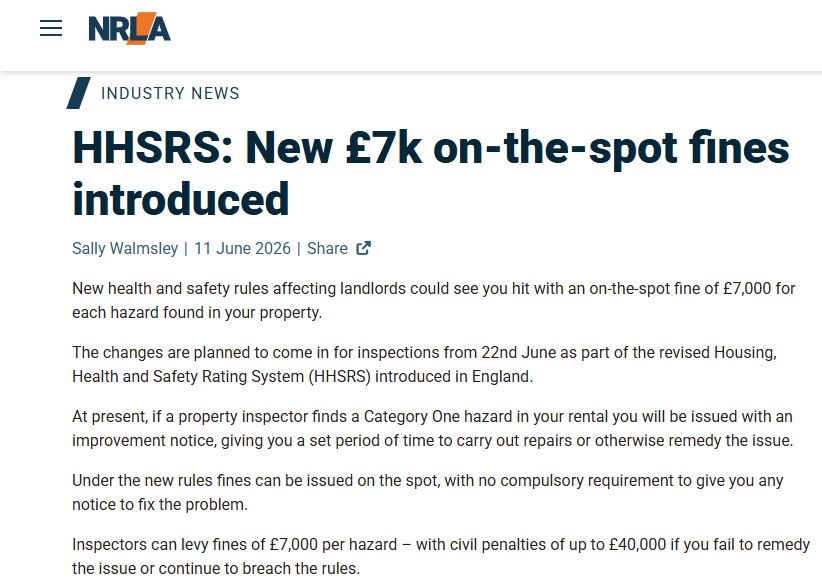
£7,000 Fines for Dangerous Rental Properties: What Landlords and Letting Agents Need to Know
Councils across England now have stronger enforcement powers against landlords who fail to address serious housing safety hazards. Here's what the changes mean for property owners and letting agencies.
Councils across England now have stronger powers to penalise landlords who fail to address serious safety hazards in rented properties, with financial penalties of up to £7,000 available under changes introduced in June 2026.
The new enforcement powers, introduced through the Renters' Rights Act 2025, allow local authorities to pursue financial penalties when serious health and safety risks are identified and the responsible person could reasonably have taken action to remove them.
For landlords and letting agents, the message is clear: identifying serious problems is no longer simply about arranging repairs. Failure to deal with dangerous conditions can now carry an additional financial consequence.
Key Takeaway for Landlords
Councils can impose financial penalties of up to £7,000 for qualifying Category 1 housing hazards. The statutory process includes an opportunity to make representations and rights of appeal.
What Changed on 22 June 2026?
From 22 June 2026, councils in England gained the power to impose financial penalties of up to £7,000 in connection with qualifying Category 1 housing hazards.
Category 1 hazards are the most serious risks identified through the Housing Health and Safety Rating System (HHSRS), which councils use to assess whether homes are safe for occupants.
Previously, councils already had powers to require improvements, prohibit occupation and undertake certain emergency measures. The new financial penalty provides another enforcement option alongside those existing powers.
Importantly, a council does not necessarily have to allow a landlord an opportunity to complete repairs before beginning the financial penalty process.
However, the penalty is not an instant payment demand made by an inspector at the property. The law requires a formal notice process, including an opportunity to make representations and rights of appeal.
What Property Hazards Could Lead to a Fine?
The revised HHSRS framework, which came into force on 23 June 2026, assesses 21 types of housing hazard, reduced from the previous 29 through consolidation.
Examples of potentially serious hazards include:
- Dangerous electrical installations that could cause electric shocks or fires.
- Severe damp and mould affecting occupants' health.
- Inadequate heating that exposes tenants to dangerous cold.
- Unsafe staircases or missing handrails that increase the risk of falls.
- Serious fire safety deficiencies.
- Structural problems that threaten occupants' safety.
Not every instance of damp, an electrical defect or a broken handrail automatically qualifies as a Category 1 hazard.
The seriousness depends on the risk identified through the official assessment.
Could One Property Lead to Several £7,000 Penalties?
Potentially, yes.
The legislation allows councils to consider financial penalties involving more than one serious hazard, and separate penalties may be appropriate where there are distinct breaches.
Two Serious Hazards in One Rental Property
Dangerous Exposed Wiring
Presents a serious electrical risk to occupants.
Defective Staircase
Presents a serious risk of falling.
Illustrative Maximum Exposure
£14,000
This is an example of possible financial exposure, not an automatic penalty. Councils must assess the individual circumstances and follow the statutory procedure.
What Happens When a Council Investigates?
Imagine a tenant repeatedly reports defective heating and severe damp, but the problems remain unresolved.
The tenant contacts the local council.
An environmental health officer may then inspect the property, examine the conditions and assess the risks using the HHSRS framework.
The council may also review relevant evidence, including repair correspondence, inspection records and previous complaints.
If a qualifying Category 1 hazard is established, the council must take appropriate enforcement action. Where the statutory conditions for a financial penalty are met, it may also begin penalty proceedings.
The Formal Process Includes:
- A notice explaining the proposed penalty and the reasons for it.
- An opportunity for the responsible person to submit written representations within 28 days.
- A decision by the council on whether to impose a penalty and at what amount.
- A final notice if the council decides to impose the penalty, with payment and appeal information.
The council's action may also require repairs or other measures to address the danger.
Why Letting Agents Should Pay Attention
Small letting agencies often manage several properties while handling tenant enquiries, inspections, maintenance requests and landlord instructions.
When a tenant reports a problem, the agent may contact the landlord and wait for approval before arranging work.
But what happens if the landlord does not respond?
A Practical Scenario
Consider an agency managing a property where the tenant reports persistent mould and inadequate heating.
The agent forwards the complaint to the landlord but does not follow up, arrange an appropriate assessment or maintain a clear record of what happened.
Weeks later, the tenant contacts the council.
An inspection identifies a serious hazard, prompting enforcement action.
The landlord may face financial penalties and repair costs, while the agency may face difficult questions about its management responsibilities, communications and actions.
Whether an agent has separate legal responsibility depends on the circumstances, the relevant legislation and the role it performs.
The practical lesson is that simply forwarding a complaint is not always enough to demonstrate that a matter has been properly managed.
How Landlords and Agents Can Reduce the Risk
A proactive approach to property maintenance and compliance can help identify potential hazards before they become serious problems.
Regular Property Checks
Inspect properties at appropriate intervals and pay particular attention to heating, electrical safety, moisture, structural conditions and fall risks.
Written Repair Records
Keep evidence of reported defects, inspection findings, contractor instructions, completed works and tenant communications.
Prompt Action on Serious Problems
Treat potentially dangerous conditions as a priority. Where the risk is unclear, arrange a suitable professional assessment.
Follow Up Outstanding Repairs
Do not assume a maintenance issue has been resolved simply because a contractor was contacted or a landlord promised to act.
Keep a Clear Record of Decisions
Record who was informed, when instructions were given, what action was taken and whether the problem was resolved.
These measures do not guarantee that enforcement action will be avoided, but they help prevent dangerous conditions from remaining unresolved.
Angel Moves: Helping Landlords and Agents Identify Risks Before They Escalate
At Angel Moves, we believe prevention begins with knowing the condition of your property and keeping reliable evidence of the action taken.
Our property risk, compliance and evidence services help landlords and letting agents identify potential issues, document concerns, monitor outstanding actions and maintain organised property records.
With stronger council enforcement powers now operating across England, taking action before a serious problem escalates is increasingly important.
Prevention Is Cheaper Than Cure.
Don't wait for a tenant complaint or council inspection to expose a property management risk. Build a proactive approach to property safety, compliance and evidence management.
Contact Angel Moves to arrange a free 30-minute consultation and find out how we can help you strengthen your property management and risk-prevention processes.
Book Your Free Consultation →Sources and Further Reading
- UK Government – Crackdown on dangerous rented homes as new £7k fines kick in, 21 June 2026. Read more
- Renters' Rights Act 2025 – Schedule 4, financial penalties relating to Category 1 hazards. Read legislation
- Ministry of Housing, Communities and Local Government – HHSRS Enforcement Guidance, 23 June 2026. Read guidance
- UK Government – HHSRS Guidance Collection, updated for the 2026 framework. View collection
Disclaimer: This article provides general information about housing enforcement in England and is not a substitute for legal advice about an individual case.
Related Posts


A Smarter Way for Landlords to Let with Confidence
23rd Dec 2025




LANDLORDS RISK FINES, BANS AND BANKRUPTCY – THE ANSWER?
19th Jan 2026
Rogue Landlords Hit With Hefty Fines After Fatal Fire
19th Jan 2026


No-Fault Evictions to End in England from May 2026
19th Jan 2026


Sadiq Khan’s landlord licensing fines near £25m
15th Sep 2026


Landlords face £3.5bn HHSRS penalty exposure
15th Sep 2026